Published
December 12, 2008
Keywords
- Summer camps,
- Mental Hygiene,
- Psychology,
- Progressive Education
Copyright Notice
Copyright and Open Access Policy
Creative Commons Attribution 4.0 International License (CC-BY-NC-ND 4.0)
1. Copyright
Authors retain copyright of content they publish in Historical Studies in Education / Revue d’histoire de l’éducation and grant the journal the right of first publication.
2. Open Access License
All content published in Historical Studies in Education / Revue d’histoire de l’éducation is made freely available online immediately upon publication under an open license, Creative Commons Attribution 4.0 International License (CC-BY-NC-ND 4.0).
The full terms of the license are available at: https://creativecommons.org/licenses/by-nc-nd/4.0/
3. No Additional Restrictions
Published content is immediately, permanently, and freely available in full text online. There are no delayed open access restrictions or timed embargoes on content. The journal does not apply technical protection measures, moving walls, or paywalls.
There are no subscriptions. No subscription fees are charged to readers.
No fees are charged to authors. (There are no article processing charges, or APCs.)
4. Directory of Open Access Journals
Historical Studies in Education / Revue d’histoire de l’éducation is indexed in the Directory of Open Access Journals (DOAJ).
Historical Studies in Education / Revue d’histoire de l’éducation
v. 3 September 2026
Licensed under CC-BY-NC-ND 4.0 — https://creativecommons.org/licenses/by-nc-nd/4.0/
Abstract
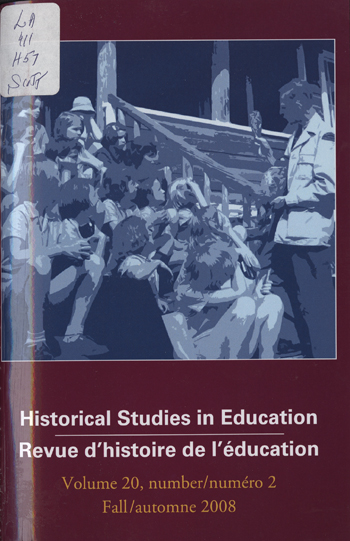
In the first half of the twentieth century, summer camps in Ontario were promoted as a much-needed escape from city living and the pathway to a world of natural, pre-modern simplicity. This paper demonstrates that, by the late 1920s, camp administrators and promoters were, in fact, pulled in two directions; they treasured the idea of antimodern escape, but, they also sought to make the camp programming “truly modern” by integrating the latest psychological and educational wisdom. At all sorts of camps, the language and aims of educational psychology and the mental hygiene movement influenced the nature of camp goals, camp programming, and thinking about campers themselves. Camp was regarded as providing the ideal environment for fostering psychological health and for applying the principles of progressive education. This paper explores administrators’ view of the value of psychological and educational expertise, the extent to which they were able to apply these at camp, and, to a lesser extent, children’s reactions to the modern, psychologized camp.